
Struggling with unstable creams,poor active solubilization and tight EU/US impurity limits?Ceteareth‑20 is the workhorse nonionic surfactant formulators quietly rely on.
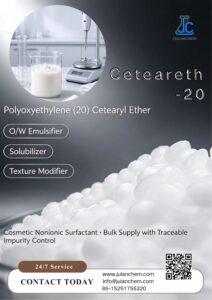
Most formulators chase trendy “natural” emulsifiers, while overlooking one reliable staple behind thousands of market-proven creams and lotions: Ceteareth‑20 (Polyoxyethylene (20) Cetearyl Ether).
This nonionic ethoxylated fatty alcohol surfactant delivers an HLB around 15.2–16.0, perfectly positioned for stable oil-in-water emulsions. Chemically built from cetearyl alcohol with 20 ethylene oxide units, it acts as emulsifier, solubilizer and texture modifier all in one package. It is the core functional component in classic emulsifying wax NF, yet many buyers only discover its full potential after failing with harder-to-tune alternatives.
What makes Ceteareth‑20 stand out for modern formulations
- Superior emulsion stability under temperature cycling It locks oil droplets in continuous water phase, resisting separation during freeze-thaw tests and long shelf storage. Formulators pair it with cetearyl alcohol to build lamellar structures for silky, non-greasy skin feel.
- Solubilizes lipophilic actives & fragrances High hydrophilic capacity dissolves essential oils, vitamin A/E and oil-soluble UV filters into aqueous systems, enabling clear serums and lightweight hydro-creams without heavy oily residue.
- Mild profile & broad compatibility Nonionic chemistry means it works well with cationic, anionic and amphoteric ingredients. At recommended use levels (typically 1–10%), repeat patch tests confirm low irritation risk for normal and dry skin types.
Ceteareth‑20 rarely works alone for heavy creams. Best results come from co-emulsification with cetearyl alcohol to balance viscosity and texture. Used alone, it tends to produce thin emulsions prone to breakdown.
Any insights?Please contact us,Julanchem,to have a deep discussion.