If you work with polyamide raw materials,you have certainly seen PA6 and PA66 side-by-side on datasheets.Many buyers and engineers treat them as “similar nylon grades”,yet few dig into their core monomer origins:caprolactam for PA6; hexamethylenediamine + adipic acid for PA66.Though both belong to the aliphatic polyamide family,their starting monomers create big gaps in melting point,crystallinity,processing window and end-use performance.
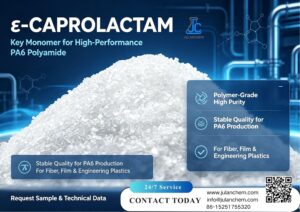
Many people ask:Are PA6 and PA66 made from the same building blocks?Can caprolactam produce PA66?What is the real difference between ring–opening polymerization and polycondensation for polyamide production? These are practical questions for chemical sourcing,polymer compounding,automotive component design and bio-nylon project evaluation.
Where Do Our Two Core Polyamides Come From
Polyamide is defined by repeating amide bonds along polymer backbone.But polymerization routes separate PA6 and PA66 completely.
Polyamide 6 (PA6/Nylon6): Built from caprolactam only PA6 forms via ring opening polymerization of caprolactam.One single cyclic monomer opens its ring and links into long polymer chains, no second co-monomer required.
- Monomer feedstock: Caprolactam
- Reaction type: Ring opening polymerization
- Melting point: ~215-225 °C
- Typical strengths:Good impact toughness, easier melt processing, cost competitive
- Common uses:Textile fibre, injection moulded parts, film, monofilament
Polyamide 66 (PA66/Nylon66):Two monomer polycondensation PA66 cannot be synthesized from caprolactam.It strictly relies on equal molar mixing of hexamethylenediamine (HMDA, ethylenediamine–type long–chain diamine) and adipic acid.
During condensation polymerization,water is eliminated to build amide linkages,forming high-symmetry polyamide chains.
- Monomer feedstock: Hexamethylenediamine + adipic acid
- Reaction type: Step growth polycondensation
- Melting point: ~255-265 °C
- Typical strengths: Higher crystallinity,superior heat resistance,better creep resistance
- Common uses: Automotive under hood hardware, electrical connectors, high load engineering components, industrial tire cord
How Monomer Choices Shape Real–World Material Trade–offs
The gap between caprolactam origin PA6 and HMDA-adipic-acid-origin PA66 shows everywhere in manufacturing:
- Heat performance: PA66’s higher melting temperature comes directly from its well aligned molecular chains built by dual monomer condensation.It survives continuous higher temperature service that degrades regular PA6.
- Moisture related dimensional shift:PA6 absorbs more moisture, bringing better impact but larger dimensional change after water uptake. PA66 delivers more stable dimensions for precision parts.
- Processing & sourcing: Caprolactam supply chain dominates global PA6 output. PA66 production is constrained by hexamethylenediamine and adipic acid availability, which explains its usual price premium vs PA6 resins.
Sourcing-related practical questions keep popping up:What raw materials do I need for PA6 polyamide production? Why is PA66 more expensive than PA6? What monomers influence polyamide melting point?The answer traces all the way back to those two starting-material sets:caprolactam;hexamethylenediamine plus adipic acid.
Emerging Trend:Bio-based Polyamide Reshapes Traditional Monomer Landscape
Today’s market sees rising inquiries for sustainable polyamide solutions,pushing discussions on bio-based caprolactam,bio-hexamethylenediamine and bio-adipic acid.
Many chemical project managers search:Is commercial bio-based caprolactam available for PA6 manufacturing? Where to find bio-based hexamethylenediamine and adipic acid for bio-PA66?What is mass-balance polyamide for CBAM compliance?
Right now,petroleum-derived caprolactam,HMDA and adipic acid still dominate bulk polyamide manufacturing.Bio-based caprolactam remains mostly at pilot-plant stage in China,with limited sample-scale output rather than large-volume commodity supply.For PA66 bio-grade,you need both bio-sourced hexamethylenediamine and bio-adipic acid simultaneously; single-bio-monomer input usually yields partial-bio polyamide via mass-balance certification.
When evaluating green polyamide projects,always verify monomer origin,bio-carbon content and certification standards, instead of trusting vague “bio-nylon” marketing descriptions.
Behind every PA6 and PA66 granule sits its monomer story: caprolactam for PA6;hexamethylenediamine paired with adipic acid for PA66.Understanding this core connection helps you interpret price fluctuation,select correct grades,evaluate copolymer options and assess upcoming bio-polyamide opportunities.
Whether you are comparing polyamide resin grades,auditing raw-material suppliers or planning sustainable polyamide projects,always trace performance back to monomers.
Should you have any views or insights,please do not hesitate to contact us(Julanchem Group/Julanchemical) for in-depth discussions.